12/19/2024

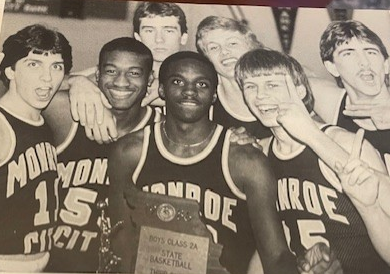
Monroe City Tournament 100th Anniversary Celebration


It was my pleasure to serve as the committee chairman for the Monroe City Tournament’s 100-year anniversary celebration.

Monroe City basketball history raises a lot of comparisons and a lot of spin-off theories. This town has been for many years blessed with good high school basketball. The paradise MC hoops has become is, to put it tepidly, getting extremely crowded. It is concurrently fun, thought provoking, frustrating, controversial, but also next to impossible when discussing different teams and eras to honor all deserving in 15-minute segments spread over only six nights. We needed the Dream Team of committees, and we found it.

If you want public credibility in the community of Monroe City, get Sister Suzane Walker to sign on. Her communication and organizational skills contributed mightily.

We wanted our celebration to be inclusive of the entire community. We identified early on that we needed a confluence of the three education entities that today are the Monroe City school district: Holy Rosary School, Washington School, and the Monroe City public schools. John A Hays, Howard Pruit and JR Chisham are masterful advocates of the three. Their passion for their Alma maters shone brightly throughout the week.

Joyce Adams and Linda Geist have great community spirit. They know, and appreciate, the history of their hometown inside and out. Their communication and writing skills are well known and they used these talents to communicate very effectively the historical information that fueled the enthusiasm we saw throughout the week.


Tony DeGrave, Ed Talton, Brock Edris and Darin Yager were our administrative link to the school district. Their approval of our agendas was the first and the last sign offs. They also took care of the stressful day-to-day logistics for the weeklong program. Your local district is in good hands.

I am not a big fan of Committees. They slow me down. I have personally searched 48 state capitals and most National Parks- and found no statues of Committees. This task needed talented individuals invested in this town, not long meetings. We identified their areas of expertise and then stayed out of the way as they went to work. The only way this type of Macro-Management can succeed is if all check their egos at the door. I knew this group would, and they did.

OLD SCHOOL TOUGHNESS

Back in the 80's team's feared the Monroe City Panthers. Style points didn’t matter. Bloody elbows along with skinned and scabbed knees did. Then that old school toughness went into a near two-decade hibernation. But now, over the past dozen seasons, Coaches Edris and Baker have orchestrated its return. As I have witnessed twice this week, it manifests itself in small ways: back cuts, help side defensive rotation and making the extra inside out pass. This year's team is young but deep. They share the ball and guard like maniacs, full open throttle.

A LITTLE HOOP A LOT OF HOLLER


Saturday evening the MC Panthers captured the championship of the 100th Monroe City Tournament, the oldest in the state, with a comeback overtime win over the Evil Empire to the east, Palmyra. The two rural Missouri towns are huge rivals, 20 miles apart.

Although the local leaders will tell you different, the rivalry is edgy. For the true Monroe faithful, who from cradle to grave curse the color Orange, it does not come any better than Saturday night.

A true fan must love rivalry games. Sports should not become routine. It should be about passion, always. However, the relationship between two good high basketball programs, like Monroe City and Palmyra, who are year after year bitter rivals is one of complexity. School administrators are on constant vigil knowing they are one misstep away from bad blood spilling over into the educational process. That cannot happen.

Civic leaders in the communities of Monroe City and Palmyra claim the competitive climate between the two neither generates nor harbor any bitterness. The two sides support each other, often as economic and social allies. Marriages between an MC grad and a PHS grad are common. Five years ago, when popular Monroe City coach Jamar White died in a traffic accident, the show of support for MC from the Palmyra school and community was overwhelming and heartfelt.


However, don't kid yourself. Bottom line, they really don't like each other. One can sense neither side would hesitate to grab the last piece of barbeque at the company picnic, leaving the other standing in line with an empty plate.

If you grew up in a small-town crazy about high school basketball, like Monroe City, count yourself fortunate. How many yards did you mow to buy your first pair of Chuck Talylors? The gymnasium is a sanctuary. When within, for a child, everything is good and right and perfectly to scale. The clanky wobbly pullout wooden bleachers packed to the rafters for frenzied rivalries.

 Some towns are known for their emphasis on schoolboy athletics. The collective community chest will swell to busting button proud when the local boys apply another “butt whipping” on those less skilled from a nearby town. Bragging Rights are never subtly applied here. Monroe City is such a town, and no apologies are made. They do here like to brag about their boys.

Monroe City’s love affair with its basketball tournament has lasted now 100 years. It remains the abiding interest of the whole small crossroads town; it is the fulcrum of wintertime social life around which the entire town will be in the small gym for the tournament (capacity 800) from 3:30 pm to 10:00 pm Monday through Saturday.

And last week was magical. Both the first seeded Panthers from Palmyra and the second seeded Panthers from Monroe City cruised through the first two rounds to set up the much-anticipated final match. It was an instant classic. Palmyra had the game all but tucked away several times with under two minutes left in regulation. But they missed an incredible ten free throws in the 4th quarter and the four minute overtime session. It was just meant to be.


MONROE CITY BLOGS

https://myemail.constantcontact.com/-Monroe-City-Blog...

 The Monroe City Tournament has for 100 years been part of a bigger local narrative. Monroe City has always treated their tournament like it matters, because it does. Using the tournament as an anchor - how events, actions, and people have intersected to build the town of Monroe City, is what we this week celebrate. There are legends behind every legacy. Now we pay civic tribute to those legends. Above is a link to 21 blogs I have written over the past two years on the legends behind the legacy of educating the youth of Monroe City.

 ORGANIZED NIGHTLY EVENTS


For the past 12 months we have had a committee of ten who have worked on organizing the 100th year Monroe City Tournament Celebration. We wanted the weeklong event to be a celebration of the legacy of not only the tournament, but the entire Monroe City community. Inclusion of the three historical education entries of the community: Holy Rosary schools, Washington School and Monroe City R-1 School District, we deemed early as paramount. Throughout the week the boys and girls Panther varsity basketball teams will wear shooting shirt/warmups with logos of all three schools whose merging over the years give us the confluence today that is the Monroe City Panthers.

The 100th tournament celebration is now a mere couple of weeks away and here is what we have planned: each tournament night will have a special 15-minute recognition ceremony, to be held between the evening’s second and third games, approximately 6:45 each evening. Monday December 9 will be Holy Rosary Night. Sister Suzanne Walker and John A. Hays will prepare the ceremony. Tuesday will be Washington School Night. Howard Pruitt and Ed Talton will present the honors. Wednesday Night will be Monroe City R-1 Night. JR Chisham, Darin Yager and Brock Edris will be the presenters. Thursday will be Team Night. We will recognize the 1956-57 Holy Rosary and Monroe City boys’ teams and the Monroe City girls’ teams of the 1998-2000 era. Dave Almany, J.R. Chisham, Howard Pruitt, Linda Geist and Joyce Adams will oversee the ceremony. Friday evening will be Legends Night, and we will honor four individuals who have been major contributors to the Monroe City Tournament, but also to the education and social development of the community. The late Galen Lankford and Cliff Talton, along with Dan Mudd, and Sister Suzanne Walker will be recognized. Saturday will be legacy night with recognition given to the tournaments oldest living male and female alums and area dignitaries. Tony DeGrave, Brock Edris, Linda Geist and Joyce Adams are preparing the evening’s program.

Make plans now to attend this once in a lifetime celebration.


11/20/2024

An Enduring Transition

In 1946, when Bob Hunskor played his first game of basketball for his hometown Newburg, ND Eagles, World War II had just ended. He went on to play as a collegian at first nearby Bottineau Community College and then at Minot State Teacher’s College. After graduating with a teaching degree, followed by a two-year stint in the military, at 24 years of age he returned to his Canadian-border hometown to help his father farm and to coach the Eagles on the hardwood. Teaching math was a required part of the gig. He stayed for 35 years. He also for the first eight years coached the girls’ basketball team, as well. The school’s enrollment never topped 40 students. Most years the male enrollment hovered around 20.


He is considered a living community treasure. More than just his sheer breadth of experience, first as a record setting high school basketball coach and then as a four-term elected state representative, it’s how Bob Hunskor has earned his exalted community status for so many years that stands out. From surviving the Great Depression and Dust Bowl eras to driving a Model A Ford, hearing the radio reports of the bombing of Pearl Harbor and serving in the military during the Cold War years, Hunskor’s life is full of tales both in an out of high school gymnasiums.

Seventy-five years after first donning the red and blue uniform of a program he would forge in his own relentless ways, Hunskor, now 94, holds a place of honor in the only hometown he has ever known. Even closing in on the century mark in age, he is no relic placed on a community shelf and rolled out only for special occasions. He squeezes in an interview between a game of pinochle at the town senior citizen center and a date in a deer hunting stand. Hunskor deflects any concern for the afternoon’s frigid temperatures with the assurance that the structure is propane heated. He is spry, mentally engaged and ready to share his thoughts on subjects ranging from modern coaches who overcoach to the red wave of 2016, that ended his 16-year tenure as the area’s representative in the North Dakota State House of Representative. He was 86 when he vacated the Bismarck state house and returned to his farmhouse home, five miles from the timeless high school gym named in his honor. The longevity of his community activism is noteworthy, for sure.

“I taught for one more year after I stopped coaching, and it was hard. I missed it but I still went to the games. I will just say it was hard,” he shares with a resigned shake of his head. It was the only time during our nearly one hour talk he dropped his cloak of stoicism.

Doing anything well for over ¾ of a century requires evolution. It requires a willingness to learn, a willingness to adapt and most importantly, it requires being involved for the right reasons. Throughout his career, first as a coach and teacher and then as a politician, Hunskor, year after year, checked all those boxes.

For his entire coaching career, the Newburg Eagles were one of the smallest enrollment schools in the state. With only two enrollment classifications in North Dakota, when the post-season began, Newburg faced opponents with enrollments up to 300 students. “We never had the depth,” Hunskor shares with me on a snowy November afternoon. “We wore down and if we had any foul trouble or injuries, our problem became even worse. We made the Class B sectional finals six times, one game short of the state tournament and then we would get beat. That was for the first 30 years of my career,” says the coach who compiled an overall off the charts record of 700 wins and 160 loses. “Finally, in1984, we broke through. We took second in the state in 1984 and 1985. We won the championship in 1986 and got second in 1989. Our 1986 state championship team had Noth Dakota’s Mr. Basketball, Chris Lamoureux, and we also had a 6’8 boy come through here then and that helped. In 1990 I had a health scare when I developed A-fib, an irregular heartbeat. The doctor, said, ‘you are done coaching.’”

For most of the 21st century the Newburg schools have co-opped their basketball team with their once hated rival, the Westhope Sioux. “In the day, we were fierce rivals,” the old coach says with no attempt to hide the competitive fire still in his eyes. “We really went after each other. These little towns up here needed basketball. It is what made the community proud. I always knew how important basketball was to this town.”

The prairie of North Dakota is littered with dying towns who have lost their schools to consolidation, cannibalized by a bigger neighboring town. On my yearly visits to the High Plains I drive through many such dying hamlets.  It is sad. I can identify the building that once was the community school. I speculate that the section of the “schoolhouse” that is two stories tall was the gymnasium. I imagine years of basketball games played on frigid January Friday nights when two small prairie towns packed it to the rafters, necessitating the opening of the windows, just to cool the place down. From the banker to the town drunk, everyone was here to witness the drama and the heroics of the local team, a respite for one night a week to the drudgery of life in a lonely prairie town. And I wonder what happened to the trophies, earned by sweat and blood and once displayed with such pride, won on those long-ago cold winter nights? Hunskor saw that no such calamity would ever hit his town. The 1986 state championship trophy is today proudly displayed in the gymnasium hallway trophy case.

Hunskor stressed that he never over-coached, a mistake he feels many modern coaches make. He kept the offense basic, and the Eagles executed it how he wanted them to, often slowing it down effectively when the Eagles didn’t have a lot of shooters. “We had plays, but the plays were just common sense on how to play basketball,” Hunskor said. He stressed the basics and repetition by running through them over and over again. “I wanted my players to think, to figure out things in a game for themselves. I did my work in practice, I wanted the games to be about the players, turn them loose and just let them play.”

In 1992 Hunskor and his family moved to Barstow, CA. “Our two daughters were accomplished violin players. My wife was a talented musician. My two sons played basketball and my two daughters were skilled (violinists). During their summers in high school, they attended Julliard School in New York. They were very good. Both went to school on music scholarships at UCLA. My son was teaching outside of Los Angeles in Barstow. So, we moved to California. I interviewed for only one job. The principal cut me off immediately and said, ‘I see you taught in North Dakota. You are hired.’ Nothing was said about basketball. I don’t know if they even checked my resume. In North Dakota, if you are a teacher, you are a good one. I am proud of being a teacher from North Dakota.”

“In 2000,” Hunskor says, “my wife contracted ALS (Lou Gehrig Disease). We moved to Reno, NV to get her treatment, but of course there is no cure for ALS. She died the next year.” Those who know him will testify to his toughness. “I survived but I needed to reconnect. I was approached about running for the state house.” It wasn't, he says today, the easiest decision to make. But he was restless, rudderless and bored. “At first, I thought the idea was crazy. But why not? I needed something to do with my time. Somehow, I got elected and then re-elected for 16 years. Then the Red Wave (Trumpism) hit in 2016 and Democrats in North Dakota were not electable, anymore,” he says with a no hint of bitterness shrug of his shoulders.

A trademark to how Hunskor lives his life is his openness to always improving and growing. He stresses basketball is a microcosm of life itself. He knows that that motto applies to him, too. “At our first state tournament game in ’84, after having worked so hard for so many years to get there, we came out tight. We threw the ball away. One of our players in the first minute of the game trips over his own feet. We were scared to death. We were down 13-4. I called timeout and before I could say a word, one of our better players, Steve Hall, came straight off the floor to me and said, ‘Coach, don’t say a word. We know we are playing poorly. Just give us a minute. We will settle down.’ So, for a minute I just stared at them and they stared at me. A very strange timeout. But Steve was right. The best thing to say was to say nothing and that told them I had confidence in them more than any words could. We settled down, came back and won the game, the next (semifinal) and took second. I learned a lot that day and I had been coaching for a long time. You are never too old to learn.”

Over the last 75 years coaching has changed. Basketball has changed. Politics has changed. The world has changed. Hunskor’s core life beliefs have not. “There was a time when these little gyms were packed to the rafters,” he reminisces. “The rivalries were intense. Anytime we played Westhope, well watch out, it was always a fight. But then we would all go to the cafeteria and eat pie together. I never considered leaving. Why would I? Here I felt here the kids listened to me.” It was the quintessential mentor rising to the surface in Hunskor: seeking the simple joy of the more subtle rewards of working with boys who were at an age when a coach is most likely to make a difference.


5/17/2024

Legacy Restored

In the fall of 2015, a new coach with a familiar name was hired to restore the Vashon Wolverines basketball program.  Tony Irons, son of iconic Vashon Coach Floyd Irons, picked up his whistle and began the rebuilding job. Oedipus himself never faced a paternal situational relationship ripe with such complexities.

“I have made it a point not only with our players at Vashon but our students as well, that they know about the legacy that my dad developed,” says Tony. “When my dad left Vashon in 2007 it wasn’t on the best of terms. That’s no secret. They pretty much tried to eliminate him from the history of the program. I have made it a point to put up the old pictures, display the old trophies, let people know about the legacy of Vashon basketball that he built.”

After Floyd Irons removal as coach of the Vashon Wolverines, and his subsequent stretch in federal prison for his role in a felony mortgage scheme, two of his former players were given the keys to the program.  First, Anthony Bonner, Irons’ best-known former Vashon player, a superstar at St. Louis University and a long time NBA regular took over the Wolverines in 2006. He resigned mid-season in 2009. DeAndre Davis, a resource police officer at Vashon and a 1992 graduate, sat in the head coaches’ seat through the 2015 season. Neither was able to keep Vashon at the level anywhere close to the lofty perch of the Floyd Irons’ years. During the tenure of both coaches, most seasons the once mighty “V” finished with a very un-Vashon like record of below .500.

It is a twisted and complicated past between the Irons coaches (Floyd and Tony), the Vashon community and St. Louis area basketball. In 2015, the son fully and voluntarily interjected himself into the brew. Floyd was never the type of father to hold his son’s hand. He is the type who will have his son’s back. Dad attends most Vashon practices and games. He sits alone, his entourage from the glory days of long ago, dispersed.

The fact that Tony is the only child of the man who ran with the “fist of Irons”, the Vashon program for so many successful years is certainly grist for the Freudian mill, but don't go too far with it. There is no question of who today leads the “V”. The son is his own man running his own resurrected version of the hoops dynasty his dad started building on Cass Avenue almost 50 years ago.

In the glory years, Floyd had a game face that oozed fury. He stomped, he screamed, he pointed and jumped like an ireful child, his puffed-up face often frozen in a sneering rictus of rage. Tony’s courtside manner is much less demonstrative than his father’ was – mostly stoic to the extreme. If father was Type A, son is Type Z.

Tony has developed his own bench persona. He paces constantly, a combination, depending on game circumstances, of a gentlemanly Dean Smith amble and a Bobby Knight High Noon saunter. His banter with his players and his assistant coaches is steady and focuses on corrections and strategy. He will raise his voice, but seldom to an official. His communication with the men in stripes is always clinical and lacking emotion or insinuation.

Jimmy McKinney was a McDonald’s All-American playing for Floyd at Vashon in the early 2000s. He played over a decade of pro basketball in Europe and then returned to work for Tony at Vashon as an assistant coach. McKinney says the two Irons’ gameday sideline demeanors may be opposite, but what makes both successful is an identical approach to practice. "Discipline drives both. Their obsession with detail is identical,” says McKinney, currently the head coach at suburban Kirkwood High.

Tony’s tongue is as whip sharp as his dads ever was. He was destined from birth to be a basketball coach, a very good one. With a clipboard in his hand, a new practice drill on his fingertip and a barb on his tongue, he says he is today exactly where God intended. Sounding like the lyrics from some 1970s soft rock love song, Tony Irons tells his players, “When you think you have given me all you have, you had better reach down and find me just a little bit more.”

Today, Floyd Irons has been for near a generation removed from his position as head coach of the Vashon Wolverines. With his son Tony now leading the north side power, Floyd Irons is a sort of conscience-in-residence. Dad is a good and willing sounding board.

The senior Irons knows his son is not a template of his dad’s style. “He is more like his mother,” Floyd says, when discussing the difference in temperament. “He has never been one to like to get out of his comfort zone, whereas I was always looking to push the limits. Still, even today, after all the success he has had, he is very low key. Tony keeps his circle pretty tight.”

Floyd Irons has always played an oversized role in the lives of his players:  a disciplinarian, a counselor, a mentor, a hard ass, a kind soul and, above all, a pedagogue. Torrance Miller, a small-time drug dealer and cell mate who taught Irons about the vagaries of the criminal justice system says, "Floyd could teach a dead rat to be deader."

Floyd’s wife and Tony’s mother, Sandra Irons lived shoulder to shoulder with her husband through that frustrating first decade. The wins always came, an average of 22 per year between 1974 to 1982, but never the Big Win. They lived in a fishbowl. Everyone had an opinion. Sandra says her husband agonized over each loss, never fully enjoyed the wins. She suggested that he attempt to develop a better relationship with the press, but he never listened.

In an age of peripatetic, keep-trading-up-for-a-better-job coaches, Irons stayed put. During his over three decades as coach of the Cass Avenue dynasty, Irons says he has seriously entertained only two offers from other schools. In the mid-1980s, Irons traveled to Rhode Island  and interviewed for an assistant coach’s position with the Providence University Friars. He says he knew right away it was not a good fit. “They wanted a guy on the road full time recruiting. I wanted to be on the practice floor coaching.” To say Floyd Irons is not cut out to be an assistant, would be a more than fair assessment, one he was wise enough to make early.

In the mid 1990’s, Irons says he briefly looked into the position at neighboring suburban school University City. “By then, I had moved into administration with the St. Public Schools, and it was a bad time. The bussing, the charter and magnet schools that seemed to be springing up everywhere, the revolving door of superintendents; we literally were watching daily the gutting of the public schools in the city.”

But as with Providnce, when it came time to pull the trigger and separate from the V, Irons could not do it. What Irons has done over the years is to gather around him an extended Vashon family of former players he could not abandon for suburban greenery; colorful and strong men like, Cody, Campbell, Trice, and Collins. Maybe not generating the endowment connections of a De Smet or a Chaminade, but they’re family.

Floyd Irons was 34 years old when he won his first state championship. Today, Tony is 35 years old and has already captured five state titles, three as the head man at Vashon. Dad sometimes worries son’s road has been too smooth, lacking in the character-building disappointments he himself endured for a decade.

“If Tony is missing anything from his resume,” Irons observes, “it is failure.”

The younger Irons, even as a player, knew nothing but success. He finished his high school career at Lutheran North High School as a state champion. His collegiate career at College of the Ozarks closed with him as a member of an NAIA national champion.

Father says son recognizes this. “This was his idea, but I loved it,” Floyd says, “comes right out of my coaching playbook. A couple of years ago Tony had his whole team back from a state championship year. That fall he made them all play soccer. Vashon has never been known for its soccer and most of his players had never played. They won one match the whole fall. I think one loss was like 14-0. He said he wanted them to see how it felt to be on the other side.”

Does the son feel the yoke of family honor to bring back the gloss to his father’s reputation? If he does, he does not show it. Revenge is best served cold. Regardless, once again, with an Irons back at the wheel, the “V” is ready to roll and the north side pride in the iconic Irons’ led Vashon basketball machine has returned with a whole new generation of passionate supporters.

“I am very family oriented,” Tony says. “I am with my mom and dad all the time, visiting at their house, going out to dinner. To be honest, my dad’s probably my best friend. My wife and I hope to be starting a family soon. Covid has kind of pushed everything back. But I’m hoping things soon are going to get back to normal.”

“It’s really been tough on our kids with the pandemic. We’ve got a couple of Division I level seniors this year that really didn’t get to show their stuff this summer in the AAU ball. Basketball is just so important to these kids and to this community. If you do it the right way, basketball can be a positive. My dad did it the right way for 30 years. I like to feel I’m doing it the right way now.”

How will it end? Regardless of how, the son has made the dad proud. “To see him bring back the “V” is truly gratifying,” says Floyd Irons of his son’s mega success.

“I could see myself someday getting into college coaching,” says Tony. “But I’m not actively looking. I think I have a great situation at Vashon. I have a chance to continue a family legacy but also to make my own mark, to have my own impact on these kids. So, if it happens it happens. If not, I’m very happy here.”

Nothing stays the same, even on Cass Ave. Evolution can have a melancholy aspect, of course. Whenever things change—attitudes or the times themselves—there are inevitably those who fade away. But today, hope has poked its head from the hole of irrelevance the Vashon basketball program had become, and the consistent tune of the pied piper played loud and proud for 33 years by Floyd Irons strums again on these north side streets.

A father is a man who expects his son to be as good a man as he meant to be. Within the Iron’s coaching tree, the son is not burdened with the restoration of his father’s legacy but, more fittingly, in 2022 is respectfully establishing his own.

Say this for the still young coach living in a fishbowl darkened by the long shadow of his iconic and controversial father, through nine years and five state titles, he hasn't yet turned into anybody but whom his parents raised him to be – simply he is Tony Irons. And, the 74 year old man who created all these expectations will tell you, that's good enough.


1/17/2024

Ballin' in 56


With next winter’s 100th anniversary celebration of the oldest basketball tournament in the state sure to shine wide ranging light on a small town with a legacy of hoops as deep as it is long, let’s ignite the argument: what era was the round ball apex for Monroe City? I will start.

The 1955-56 season. The Panthers over at the public were on a decade long magical ride, averaging 28 wins a year. Holy Rosary, on the other extreme, was a losing program DOA. But now the Trojans had a new fire ball of a coach destined to make this a two-team town. And a future Army Brigadier General would that fall racially integrate the Panther locker room.

Like most small towns of the time, the Monroe City, MO of the fall of 1955 was clannish. If you were Protestant, you lived north of the railroad tracks that dissected the one whistle stop town. If you were Catholic, you lived south of the railroad tracks. The only exception being the two streets that ran parallel, one on each side of the tracks. That is where the town’s black population of the day domiciled.

Over at that public “Protestant” high school on the north side, the MC Panthers were coming off a 30-5 basketball season. Over the previous five years those heathens had won an unholy 152 games. Heck, at the rate the local Catholic boys at Holy Rosary were staggering along, there would be a man on the moon before this cadaver of a team ever won 152 games. Something had to be done. How desperate were the Catholics to catch up? They hired a Baptist for their coach.


Coach Ozzie Osbourn’s reputation for his knowledge of the game of basketball immediately set him apart from his predecessors at Holy Rosary. “He was the first real coach we ever had,” recalls 1958 grad Chuck Kendrick. “And we hung on every word he said. Before we would have a dad, or some local who maybe had played in high school, volunteer to coach us and it just wasn’t working. When Ozzie came over, we knew immediately we had something special.”

By that summer of ’55 the public MC bunch had been on quite a run. In the fall of 1946, Coach Morrie Schroeter came to town. He found a community ready for some fun.  Schroeter’s first team recorded a record of 25-10, his second 36-8, falling one game short of the 1948 state tournament. Schroeter’s final two teams in 1951 and 1952 both won 30 games: 31-8 and 31-11 respectfully. The 1951 team fell to University High of Columbia, the eventual state champs, in the semifinals of the regional. Schroeter would stay one more season.

In the fall of 1952, Billy Key moved up from Wellsville and took the helm of the Panthers. His tenure was for four years, and he would compile a record of 106-27.

Key departed not only Monroe City in 1956, but the high school coaching ranks, as well, taking the head coaching position at Harris Stowe College in St. Louis, MO. He would later spend 23 years as the head coach at the University of Missouri-Rolla. In 1988 he was elected to the Missouri Sports Hall of Fame.

Jim Gottman was a star player and a MC 1957 grad. The catholic boys, he is sure, over at Holy Rosary knew well the corporal wrath of a no-nonsense nun’s ruler, but Gottman says the nuns were sandlot wannabe sluggers compared to the Micky Mantle home run stroke of Coach Billy Key. “Coach Key was a disciplinarian,” recalls Gottman, a long-time area farmer. “You did not want to cross him. He had a rod, a stick, he would carry around with him and he didn’t hesitate to use it on your rear end, if he thought he needed to get your attention. I remember one night we were playing Palmyra. At half time he was really upset with how we were playing. He got out the stick and he stung our butts good. And yeah, we did come back and win,” Gottman says with a laugh.

 At MCHS, 1955-56 was a school year of change. Panther teams had always, until 1955, taken the basketball floor in their traditional colors of Black, Gold, and Caucasian.

 From their basketball inception in 1925, when the team went winless in five games, through the 1955 season - the same year Rosa Parks refused to give up her seat to a white man on a Birmingham, AL bus and the year after the Supreme Court ruled in Brown v. Board of Education that racial school segregation was unconstitutional - Monroe City maintained segregated high schools.

 In the fall of 1955 Donald Scott racially integrated the Panther’s hoops team. Scott missed a significant part of the season when he was felled by an appendectomy. He would go on to a military career, retiring as a US Army Brigadier General.  He was later appointed Deputy Librarian of Congress and served as Chief of Staff for Atlanta mayor and civil rights icon Andrew Young.

Holy Rosary had a new gymnasium, opened in time for 1955-56 season, the Father Connolly Gymnasium. The Holy Dome, as the structure would become affectionately known, was ahead of its time. Even the hotshot Panthers over at the public school and their bandbox size “gym on a stage,” looked with envy at the Trojans home court. It would be another decade, until the 1960’s, and the zenith of area rural school consolidation until huge, clean field houses began springing up like Levittown’s to replace northeast Missouri’s many tiny bandbox gyms.

From the day it opened its doors, the Holy Dome was known as a tough road trip. Holy Rosary 1958 grad Chuck Kendrick says the Holy Dome mystique was just hype and nothing more. “We won because we had better players.” Area rivals did not see it that way and often loudly cried, “HOMER”!

Long-time Paris Coyote’s coach Donnie Williams in time just accepted the Trojan’s home court advantage. “You were 10 down when you got off the bus,” he once groused, in only the way the rough around-the-edges, burr haircut Williams could. “Then you go inside and see the crucifix behind each basket and figure with God on their side, there goes another ten points. Now it is 20-0 and we are not even in the locker room, yet. Then when the officials walk in wearing their Knights of Columbus hats, you just figure what the heck, let’s just get back on the bus and go back home.”


1/14/2024

Isaac Run

That old stretched-leather feeling makes his whole body go taut, gives his arms wings. It feels like he’s reaching down through the years to touch this tautness.”

John Updike

Why such fascination with talent left fallow, with the greatest that never was? We respect the overachiever but quickly pass to the prodigal, fixated on those who toss away the gift, failure manifesting as legend. Tragedy endears when potential fails to endure, lingering as a restless reminder to our subconscious of what could have been.

John Updike in 1960 wrote a novel destined to become and American Classic, titled Rabbit Run. Updike recorded the unfulfilled life of a 26-year-old former high school basketball star turned reluctant salesman, desperately seeking a role in adult life that would recapture the fleeting fame he briefly knew as a teenage local athletic hero.

Rabbit Run is a dark, brooding and sad story, often boarding on the macabre, but one commonly true in a society that makes a hero of a mere child who can outrun, out jump and out throw the best rival towns can offer. It is a sad story played out time and time again in small towns across the land: the fleeting fame of a school boy star that, at 18 years of age, is slapped with the reality that the final whistle has blown and your best days are now behind you. You become yesterday's hero, booted into adulthood and replaced by a new star of the local high school team. You drift to the bleachers, a few rows higher up each year, until you finally stop going at all because it hurts too much.

To provide him the promised anonymity, I will call him Isaac. "Hey man, I got to live here," he told me. In exchange for his candor, I promised to protect his identity. For that reason, I give the town the fictional name of "Wilson," the school mascot the "Panthers."

Short and of average build, it was hard to see Isaac in the role he had so well played only a few years before; small town football hero. Fulfilling his now adult role as cashier, he gave me my change from a purchase of gas and sunflower seeds I had made at a non- descript convenience store in a sleepy town I was passing through late one fall night. Adulthood had mandated that he trade in his bright red Panther game jersey for a baby blue smock with a button attached to the right breast pocket promising service with a smile. I would never have pegged him as a local legend.    

Had business not been slow on that late evening, perhaps neither he nor I would have had the inclination to progress in our conversation past the normal niceties one exchanges with the locals as a faceless stranger in a nameless town. But being as no other customer or employee was in the store as closing time approached, Isaac with no pressing job responsibilities, asked, "where are you heading?" Not having any impending place to be that evening myself, I had the time to respond in detail. "Cool," he told me, after I explained my wandering travels of the back roads of the nation's Heartland in search of the social meaning of high school football. Isaac, I was to learn, was one of only a handful of African Americans in the town of 5,000. "I used to play football," he told me.            

Accepting an offer to join me for a beer after work, Isaac readily agreed to fill me in on the local high school football fortunes. "I lock the doors in ten minutes," he said. "Take me ten more minutes to clean up and close out." I waited in the car as he finished his duties.

By ten minutes past 10 pm, we were both seated in a cozy corner booth of an establishment on the town square that served as the local pub, turned sports bar. In a building as old as the town itself, pushing a century of use, the watering hole served as a haven for the loafers and the local sports experts, who were often in this town, Isaac told me, one and the same. 

It was pure small-town America, both inviting and boring, but the hot stove chatter, for a high school sports fan such as me, was fun to listen to. The pool table was in use, the one TV above the bar broadcast 24-hour sports news and the waitress who took our order had nicotine breath and called me "Hon."

The local team wasn't doing so good, one of the pool playing patrons told me. Even though early in the season, he blamed it on coaching.  His 8-ball partner disagreed, diagnosing the problem as one of "a bunch of lazy ass seniors. We need Isaac back out there," he said loudly as he threw his right arm around my new friend. Even as a stranger, in the company of a local legend, I felt at ease.        

 Our waitress arrived with our first round of beers. She also was pleased to see Isaac, as were the half dozen other locals bellied up to the well-stocked bar, bottles of beer systematically tilted back at least twice a minute. Isaac, I was to learn in the course of the evening's conversation, had carried the local squad to within "one bad half" of post season play, hollowed turf never before or since traversed by the local team. The defeat of six years prior was still, I could tell, a bitter pill for the local populous to swallow.

"I came here the summer before my senior year," Isaac said as he began to spin his story of gridiron glory. "I grew up in Kansas City (MO) with my mom and stepdad. I never played many sports. I quit football my freshman year. I didn't like the coach. The team was terrible. Everything about playing football there was bad. No equipment, crappy fields. We played our games on Saturday mornings, and nobody came to watch us. Coaches didn't care. Half the time the officials wouldn't even show up. It was a waste of time."

Wasted time, though, for an unsupervised street kid such as Isaac had become, was a problem. "I had way too much freedom. I hit the streets and ran with the wrong crowd. I was on my way to the state penitentiary, for sure. We did dumb stuff. Break out car windows and do $600 of damages to steal a pack of cigarettes we could see on the dash."

Caught stealing by the police twice his sophomore year of high school, he was subsequently twice taken to juvenile court. "I called myself a sophomore because I wasn't old enough yet to drop out, but I had pretty much, by that time, quit going to school. If it was really cold out or I was hungry and wanted a hot breakfast I might go, but I wouldn't stay. No one ever came looking for me. Just one less dead-end ni##** they didn't have to worry about, I guess."

Isaac's second brush with the juvenile court system landed him a thirty day stay in a county youth lock up facility. "They called it a school, but wasn't nothing more than a jail; bad, bad, bad. I was in with two fifteen-year-old dudes that had shot and killed a kid right in the front of my high school in broad daylight. They knew (because of their age) they was only going to be locked up till they turned 21, but man they had the rep now on the street, know what I'm saying? Dudes didn't care. If you weren't strong and wouldn't fight, well come nighttime, they would make a punk out of you. That wasn't going to happen to me. I'd fight, so most were cool with me."

The month-long incarceration was an eye opener for the sixteen-year-old. "Set me straight and it wasn't anything the system did, either. The school in there was a joke, worse than my public high school. But man, I could see myself as a future con, in and out of the system, if I didn't get it together, know what I mean?"

Upon his release, Isaac had a heart-to-heart talk with his mother. "She was only fifteen when I was born. She had been in and out of foster care herself. She was more like a big sister to me. I never gave her the respect one should to their mother, know what I am saying? She never talked about my dad much. I never met him. I heard he was a very good athlete himself in the kid programs but couldn't stay out of trouble when he got to high school, so he never played, just ran the streets and got into the whole gang thing deeper and deeper. The same road I was going down my momma pointed out. I think my dad is in prison now, but I really don't know for sure."

“Hon, you need a refill?" I bought a round for the whole house, including our waitress. Four at the pool table, the four left at the bar, me and Isaac. Eleven beers, $26.75, total.

"My mom had a cousin who had married a white girl from Wilson and moved here with her. I came to live with them after Christmas my junior year. We thought a small town and a fresh start was what I needed. We never even thought about football. It didn't work out (with his first host family), but by then I was pretty well known in town and one of the teachers let me move in with her and her family for my senior year."

It didn't take long for Isaac to show his new hometown that he possessed the one ingredient that had for years been lacking with the Panthers: speed. "I ran track my junior year," said Isaac. "I did it for something to do, to get out of school early and to flirt with the girls, both ours and at the other schools. Only time I really saw many sisters," he said with a laugh.

"It took a while to get me eligible with all the paperwork that had to be done because of my transfer. It was almost the end of the (track) season before I could run in a meet, but I remember I broke the school record in the 200 (meter dash) and that opened some eyes, including mine. To be honest, I don't know how they (local school officials) got me eligible, what with me having basically no grades for about a year and a half, because I was not going to school on a regular basis. But somehow they did and I am glad of it." Glad also would soon be local sports enthusiasts as it took only the first carry of the first football game the following fall for Isaac to find his true athletic calling, running a football.

"I didn't start the first game (of the season)," he recalled. "But I went in the second time we got the ball.”

"The plan was for me and another back to share time as the main running back.” Isaac said. That plan was soon forgotten as Isaac scored a touchdown the first time, he touched the ball. Later, when I talked to the man who was, and still is, the head coach of the Wilson Panthers, he spoke with a sense of awe of how quickly Isaac grabbed onto the role of savior of the local team. "We threw him a pitch out around the right end," the coach told me. "We (coaches) had questioned some the willingness of Isaac to get hit. He never was much of a practice player, but that first time he touched the ball in a live game, we knew we had something special. He was a gamer."

 According to the coach, that first carry has become a part of local lore. "We counted on the film; he got hit 14 times and never did go down. He had two on his back he was carrying when he crossed the goal line. We still show that tape several times a month. He went 70 yards for a touchdown, but I swear he ran 150 yards, back and forth across the field, on that one carry. I still get chills thinking of it."

The town had a new hero, and the recipient of the adulation was more than willing to play the part. "I still can't believe how lucky I was," said Isaac. "None of this was planned. I just wanted a new start where I could get my education and stay out of the penitentiary. And then, wow, I am the star. Overnight. Talk about being in the right place at the right time."

Isaac's rookie game showing was no fluke. He went on to break the school rushing record. More accurately, he demolished the school record by over 500 yards, finishing the season as one of a handful of backs in the state to gain over 2,000 yards rushing.

Just as quickly as it began, it was over. "We lost a couple of games during the year, but we got into the playoffs and were really on a roll, and all of a sudden, the season was over." One bad half in the third round of the playoffs burst the bubble. "We were up two touchdowns at the half," recalled Isaac, "and then everything went wrong. Fumbles, penalties, you name it, if it was bad it happened to us that night."

The locals fell by two touchdowns. "I was just in shock after the game," Isaac reminisced six years afterwards. "I remember after the game, just sitting alone in the locker room not wanting to take off my uniform, not believing it was all over."

For Isaac it was the end of a dream. "I remember how I couldn't wait to go to school each day. Man, would my teachers back in KC been amazed. Me wanting to be in school," he said with a chuckle. "Girls, girls and more girls. I ended up in the back seat of many a white girls’ daddy's ride. Know what I am saying? I was in heaven. You know what is funny; I still see a lot of those same girls today, white girls with money. See em when they come home from college. They wave, but don't really have time for me. But I remember, and I know they do too."

His eye-popping stats had put Isaac on the recruiting radar screen of many smaller colleges. His high school coach tried to keep expectations reasonable. "People around here have such tunnel vision. They see a local star and think he is on his way to the NFL. They don't realize how many good players are out there. In some of the better big (high) school programs, Isaac might have never even made the team. Isaac was a very good small (high) school player and I wish we could have had him all four years. But his size and speed said he should be playing at the D II or D III level (smaller school classifications of the NCAA) in college. But Isaac kept waiting for Nebraska, Texas and Oklahoma to come calling, and that just was not going to happen. But you know what, it doesn't matter. What does matter is that for one magical run of a couple of months, Isaac was 'The Man.' He owned this town. How many people can say that?"

As it turned out, the point of what level he could play on was mute. Isaac's lack of academic achievement came back to bite him. He could not muster the tests scores needed to qualify for an athletic grant in aid. Both his ACT national test scores and his local grade point average were insufficient for him to play at an NCAA school.  Junior college was an option that was explored by Isaac and his coach, but eventually they settled on an NAIA school whose admission standards were not as stringent as what the NCAA held. It was a bad fit from the start. “They promised me the moon but when I got there it was a big let town, everything, the school, the town the coaches; they lied to me."

Isaac was to learn, as Simon and Garfunkel sang in the Boxer - for a pocket full of mumbles such are promises. “Coaches there were crazy,” Isaac shared. “I mean it, they were nuts. Some of the stuff they did in practice was just stupid and dangerous."

Isaac's lackadaisical attitude toward practice, coupled with the higher level of competition on the college level, was a combination that doomed the young man who had not been raised in a football culture, not programmed to accept competition as a challenge to improve, to fight through adversity and show the coaches he had the desire to pay the price to play college football.

"I remember my position coach called me in and told me 'When the going gets tough, the tough get going,'” recalled Isaac, “and that is just what I did, got going right back to Wilson," he recalled with a chuckle.

Returning to the only town where he had ever been told he mattered, even if it was just because of football, Isaac was back in Wilson before the end of September. "I found a few odd jobs to keep me going and I loved going up to the school every afternoon to watch practice. And I just couldn't wait until 7 pm each Friday and game time. People (at the game) knew me and spoke to me with respect."

Torn between leaving the only support system he had ever known, but still wanting to follow his college football dream, Isaac once again tore himself away from Wilson and for the second semester of his freshman year, enrolled in an out of state community college. "I liked it all right. Since it was winter, the football was not as intense yet. We lifted and had off season workouts, but it wasn't hardcore, and I liked my teammates. I was at a school in a small town without many blacks, a lot like I had experienced here and that was cool with me. Tell you the truth, in that environment and being black, I felt kind of special."

The problem with this stop in Isaac's pursuit of a football home was academic. "I just couldn't get the book work done. I tried, I really did, and I didn't do badly, I just didn't do well enough. At the end of the semester, the coach called me in and said that my grades were good enough to stay in school and good enough to be on the team. But since I was from out of state, I had to have a higher-grade point average to keep my scholarship, and I didn't have it. If I was to come back to play in the fall, I would have to pay my own way, and I just didn't have the scratch to do that."

As a two-time loser in the college placement game, Isaac's choices were now limited. He and his high school coach finally found a small NCAA Division III school in the north that could parlay a combination of loans, grants and local scholarships to help Isaac generate the $40,000 plus it was going to cost him to attend this private institution with a great academic reputation.

"It was the chance of a lifetime, I know that now," he says as he looks back with four years of hindsight. "It was an environment that I had never been in before. Money, money and more money. I think I was the only one who didn't have much. Even the other brothers on the team came from families with money. My (black) roommate's parents were both lawyers. But people were cool with me and I was treated well.”

Isaac still has a hard time explaining why he left. "I blew it. I could have stayed. I had a good year, not a star, but a good sophomore year of playing ball. But I just couldn't make myself go back for another year. It just was not the same as in high school. The coaches wanted to win, but not like we wanted to win here. If we lost in college, that year, it was no big deal. By the next day we were over it. Academics were more important (than football). You could miss practice with no penalty, if you needed extra time for a class. That would have never happened here (Wilson). And nobody came to our games. People around school didn't treat me special because I had a good game on Saturday. By Monday, I was just another kid in history class. That whole summer leading up to the next year, back in Wilson, I just couldn't get myself motivated to work out. I keep telling myself, 'tomorrow I will get started.' But I never did. By the first of August, I finally was honest with myself and told people I wasn't coming back. I know I let a lot of people down."

“I guess the best description of my college career would be: First Team Failure.”

Isaac returned to his adopted hometown knowing that, for all practical purposes, his football career was over. "I continued to work out, continued to dream, but deep down inside I knew it was over. And I knew that without football, my life didn't mean much."

The one-time high school star continues to help the local team in a peripheral way. He has considered coaching but knows that without a college degree and a teaching certificate, all he can do is volunteer work with younger players. "I still go to high school practice a couple of times a week. And I help out with the little league program on weekends, but it just isn't the same. All I want to do is play."

"You know what is funny about football? When your school career ends, that's it. You are done. With baseball or basketball, you can still continue to play, slow pitch softball or city league basketball. The outlet is still there. But with football, it is gone in a flash. I was at the top of my game in that regional, and then bam! We get beat and no more. I know I will never play again. I have accepted that, but it still hurts. What I wouldn't give for just one more week of practice.  It doesn't have to be a game. I just want to feel special again. But that isn’t going to happen”.

"The worst time for me is when that first cool front comes in about the end of September, when you need a jacket at night. It just takes me back, back to that fall. It was magic and I know I will never feel so needed, so purposeful again. On Friday game nights, about 6 pm, the lights go on at the stadium. I can stand outside the store, look across town and see the glow. I close my eyes and remember. It is like I am back there, padded up and ready for war, but in control, because my life has meaning again. Everyone in town is there, young and old, -the whole town - at the game, coming to see me perform. It is my time and my world. It is the best feeling and the worst feeling, all at the same time, all wrapped into one."

Our waitress returned. "It’s getting late guys. Ten minutes to closing time. One last round?" she asked as she cleared from the table our night's work of empties.

The pool game concluded and one of its' four players, an overweight middle aged white gentleman with an ample paunch, approached our table. "Let me tell you something," the intoxicated man slurred, as he reached down to hug Isaac. "You should have seen this boy run that football. That is what is a matter with 'em boys up at that schoolhouse this year. No speed. What we need is another little monkey like Isaac."

Amongst a morose backdrop of no name dead-end drunken nobodies, the greatest running back in local history sadly shook his head side to side in quiet resignation to his fate. After a long-drawn swig to empty the final bottle of beer of the evening, the only 2,000-yard rusher in the history of Wilson High stood and headed for the door. It was closing time.