|
| Coach Wright |
Margie Wright was born in 1952 in Warrensburg, Il, a small farming community with a population of 700 located ten miles of corn fields northwest of Decatur. When she was 10 years old, she became the first girl to make the cut for her hometown’s Little League baseball program. The league had been for years sponsored by the local fire department and was a mainstay on the small town’s summer schedule. Each of the four teams of 10 or so players were issued a numberless tee shirt of a different color with a "Warrensburg Fire Department" ironed on stencil adorning the front. Her team color was red.
Every kid who ever played Little League baseball knows this rite of passage. You tried that shirt on at least five times the night before, posing and mimicking each time in the mirror, trying for that perfect Juan Marechal leg kick. You would even wake once in the middle of the night, checking to make sure that sucker was still in your bedroom dresser drawer, safe.
Her manager told her dad after the first practice, “We have a problem.” Because she is a girl dad asked? “No,” the coach said, “there is not a boy in this town who can so much as hit a foul ball off her. She is the best 10-year-old pitcher I have ever seen. That might not go over well.”
As she warmed up for her first game, she had the ball literally ripped from her hand. The local Women’s Auxiliary had held an emergency meeting that very evening, across the street from the ballfield in the town’s tidy little city hall building and the head Karen of the day had rushed to the scene of the developing cultural outrage, arriving in just the nick of time. No girls allowed; she told the league organizer. The man approached her dad with the bad news. Nothing I can do, he said. I am not telling her, said dad, you are. You want to break a little girl’s heart, then you tell her yourself.
Margie sprinted the three blocks from the ball field to her family’s house, threw her red tee shirt, her very first uniform - in the trash. She locked herself in her room and cried for two days. When she emerged, she demanded to know why God had punished her by making her a girl.
In writing a Title IX based tribute book to the improbable story of the 1975 Red Bud, IL High School Volleyball team’s state tournament run, one player, Cindy Guebert, suggested I locate and interview Coach Margie Wright. “She coached three of us on the volleyball team at Eastern Illinois University. She was not much older than us, but she was a great coach,” Cindy said. I found out later she had coached a fourth member of the Red Bud 6 in softball at Illinois State. Was she married; I ask. Cindy says she thinks not. That helps, married names complicate a search.
Sounded like a great segway to my putting a face on Title IX, so I hit the cyber trail. I spend the good part a frustrating day, always one internet campfire behind Coach Wright. There are over 300 Margret Wrights on the Whitepages.com site, alone. I almost, a couple of times, gave up.
I start in Charleston, IL at Eastern Illinois University. The Sports Information Office website has records back to 1975, the first year they had a volleyball team, and a Margie Wright was their coach for the years 1977 and 1978 She was very good at it, with an 85-10 record. But the young intern, when I call, has no idea where she went. A story in her archive says she was from Warrensburg, IL.
 |
| 1998 National Champs |
I estimate she was about five years older than the Red Bud girls I am writing about, so I search and find online the 1970 Warrensburg-Latham, IL High School yearbook. As I click the screen arrow to turn the pages, I catch a break. In the senior class section, I find the coffered image of a Margret Wright. And I uncover a secret so dark I am sure she has lived the last 52 years dreading that cover blowing knock at her door.At the local city hall, the lady says yes, she knows the family, but both parents have passed but she thinks there are a couple of brothers over around Bloomington, but she is not sure of their names. She knows Margie had gone out to somewhere in California and she had heard, had done well.
One of my Red Bud 6, Deb Stamm, texts me that she had played softball in 1980 at Illinois State and Coach Wright was her coach.
I search the terms, “Coach Wright softball Illinois State” and my computer screen lights up like the million dollars pull on a Vegas one-armed bandit. Jackpot! She was an All-American player and then a championship coach. I don’t want to get ahead of the story, but she ended up coaching at Fresno State in California and her face is included on any internet Mt. Rushmore like tribute to the sport’s coaches. She was very successful.
I access the Fresno State University Bulldog official athletic department website. I get passed around by a confusing setup menu but finally it is confirmed that according to a Hall of Fame announcement, Wright had retired in 2012 and moved back to “the Chicago area, to work with youth softball.” Hmm, that still covers a lot of territory, but we are making progress and, remember, still I have an ace of scandal in my back pocket.
I tried LinkedIn and discovered a Margie Wright listed as a softball instructor/coach in Aurora, IL. I call the number. It is a Chicago area softball training complex. Been gone from here for years, I am told, try this other club. I get passed on to three other traveling team/personal training coaches until I finally hit land with a call to a Rec Department office in the Chicago suburb of Wheatland. The director not only knows her but has her cell phone number.
I feel like I have been chasing the ghost of Greta Garbo, the reclusive star who just wanted to disappear. I am exhausted but more determined than ever. This is my last hope. This guy in Wheatland is tantalizingly sadistic. “I cannot give you her number, but I will call and leave her a message and see if she calls you back. But I will tell you she has a tight circle, and she normally never calls me back.”
“Oh, she will call me back,” I say in my best gangster croaking whisper, “you tell her I have seen her high school yearbook and I know she was a cheerleader, a cheerleader!!”
Fifteen minutes later I am conversing live with Coach Margie Wright and her story was well worth a full day of traversing the often-cloudy smoke signals of the cyber world.
Margie Wright was the head softball coach at California’s Fresno State University from 1986 to 2012. She coached Fresno State University to 1,457 wins and in 1998 a national championship. Her team was the last softball team from a non-Power 5 Conference to claim the national title. The way “football” money now dictates major college athletics, it could well never happen again.
Coach Wright is the winningest coach of collegiate female athletic teams, ever, in any sport at any level: NCAA, NAIA, JUCO, and in any division of the proceeding, in history. As in EVER. And she played on the National Softball Elite level until she was 44 years of age.
Let that sink in about this one-time Warrensburg-Latham High School cheerleader. And I burned up Wikipedia and surfing the net for a good six hours verifying it all.
 |
| 1973 All-American |
But she had never felt as broken nor as confused as that day in 1962. For as long as she could remember, every neighborhood friend she had was a boy. Together they played baseball every day, all day, all summer, she was just one of the guys. Why did being a girl mean she couldn’t play baseball? At times like this, who could blame a precarious childlike Margie from asking her mother why God had punished her by making her a girl?Those who loved her said it is just a tomboy phase and it would pass. And it did. Or so the adults thought. She grew into a classy and well-rounded young lady, smart, pretty in a cute way, and popular. Margie was a varsity cheerleader and a homecoming queen attendant, the perfect female offspring of a 1960’s MId-America farm town. Her listed activities, noted in the school yearbook, was longer than the Great Depression.
At her graduation in the spring of 1970, Wright’s parents basked in the wave of compliments for the fine daughter they had raised. She had a promising future as a small-town farmer’s wife, so it seemed. But she had a secret. On the backside of their modest home, she had drawn four circles, each the size of a softball, representing the four corners of a softball home plate. Outside of prying eyes, she spent thousands of hours in that backyard teaching herself the windmill-style of throwing a fast pitch softball. If the world ever got fair, she would be ready.
Decatur, IL was only ten miles from Warrensburg. In the 1960’s Decatur was a thriving community of 80,000. Many locals, Wright’s dad one, worked at the iconic A.E. Staley factory - an agricultural plant. On the weekends, Margie remembers, her dad also moonlighted as a truck driver, for years running a route to Chicago and back. It helped feed a household of seven.
Decatur has always been a big sports town. Back in 1920 the Staley Company had sponsored a football team led by a young local former New York Yankees major league baseball player named George Halas. Once, in 1919, Babe Ruth, pitching for the Boston Red Sox, struck Halas out. He couldn’t hit a major league curveball and he was released after a cup of coffee big league career. He came home to Decatur and took up his other love, football. His team was known as the Decatur Staleys, sponsored by the agricultural giant. Most of his players worked for Staley. His pigskin team was a charter member in a new circuit called the National Football League. The team never caught on locally. In 1922 Halas changed their name to the Bears and moved up the highway to Chicago.
In 1969, the summer before her senior year of high school, the now 17-year-old Margie Wright heard a rumor that would drastically change her life’s trajectory and the future of women’s college athletics. Illinois State University, an hour away in Normal, was going to start a women’s athletic program, beginning with a basketball team. Now, she had, if she wanted it, a path out of Warrensburg and a chance to start living out her long-repressed dreams.
“If my friend from my summer softball team, Cheryl Birkhead, had not told me about Illinois State starting a basketball team," says Wright, "I would never have left Warrensburg. I had no plans of attending college. I likely could have ended up marrying and staying in my hometown. I was headed that way. Most girls who graduated with me were married by the time we were 20. And maybe that would have been alright, maybe I would have been happy taking on that life. But I am glad I had a choice, and I am glad I went the way I did.”
There are a lot of women spread throughout the world of today who once fell under the umbrella of the motivating power of Margie Wright who owe Cheryl Birkhead a big thank you. And there are a few administrators who once passed through Fresno State University who rue the day Cheryl opened her big mouth. For them, life would have been so much simpler if Margie had stayed down in Warrensburg, IL.
We don’t have the money, her parents reluctantly told her, to send you to college. So, in the summer of 1970 the recent high school grad drove herself over to Decatur and found a credit union willing to give her a tuition loan. She would figure out the room and board half later. For four years she repeated the process; borrowing more after first paying off as much of the balance as she could. It took her twenty years to pay off the last of those tuition loans, but she notes the interest rate was only 2% and now she had what she needed to live an impacting life beyond central Illinois. She says it was a good deal.
 |
| Margie Wright Diamond |
The school, Illinois State, let the women have their softball team and left them alone because they asked for little. The University never offered much of any help, either.
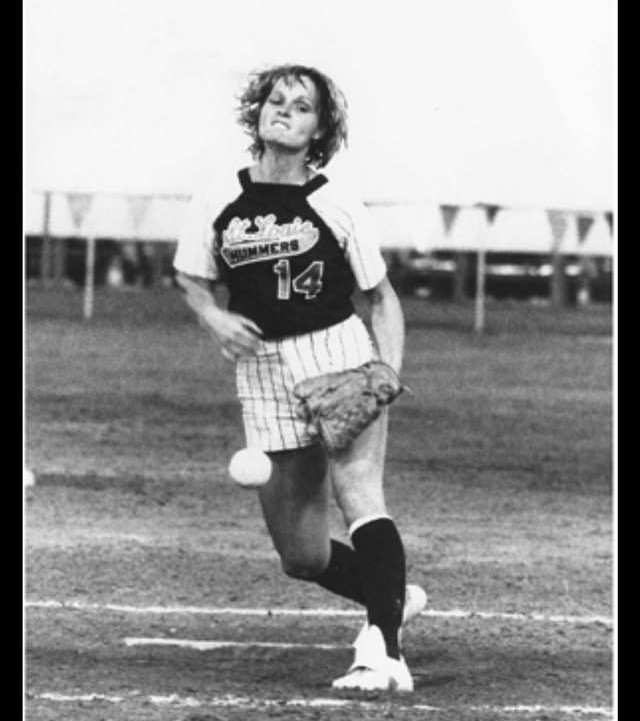
At age 21, eleven years after tossing her red Warrensburg Fire Department little league tee shirt in the trash, she was named the best collegiate softball pitcher in the nation, a First Team All-American. It was 1973, the year after Title IX was passed, but still a few years before it would become an established edict that the federal courts would enforce. Most college and high schools were fighting the law, resisting implementation. Wright was one of the many pawns in a huge political tussle.
That spring, the do-it- all Wright pitched, hit, and willed her still unfunded Illinois State team to the college softball World Series, held in Omaha, NE.
The 1973 women's college softball World Series was a gathering reflective of the wild west like days of early college women’s athletics, truly a populist celebration of the “I am women hear me roar” activist mantra now sweeping the nation - a mixture of small and large, public and private colleges and universities. There were no divisions, just a pure winner takes all format.
It was a colorful time, the tournament characters a lost caravan of a couple hundred elite and unappreciated women athletes, following the sun, in search of recognition and respect they could never quite seem to find. While low on funding and recognition the weeklong carnival of competition was awash with the type of Esprit de Corp that only common commitment to an uphill battle can foster, only money can kill - and in time it would.
The 16-team lineup consisted of: defending national champ Arizona State, Ball State (Indiana), Iowa State, Illinois State, Kansas, Michigan State, Nebraska–Omaha, North Dakota State, Northern Colorado, Northern Iowa, South Carolina, South Dakota State, Southwest Missouri State, Wayne State College (Nebraska), Weber State College (Utah) and Western Illinois.
The ISU Redbirds storming out of the gate, defeated in order Iowa St 2-1, Wayne State 10-0 and Southwest MO State 5-1, to reach the upper bracket final in the double elimination tournament. In their fourth game on the second day of the tournament, they dropped a 9-2 blow out decision to Arizona State. There was no time to lick the wounds.
 |
| ISU 1974 |
Illinois State now faced the daunting task of on the last and championship day, May 20, of winning three consecutive games, the last two over the consensus best team in the land, ASU. If they could pull it off, they would be National Champs. Arizona State only needed to win one of two. But Illinois State in Wright had one stud pitcher itching and ready to go until she dropped. This was her time and the hours of toil throwing alone against the back of a small house back in Warrensburg. IL had prepared her well. No one on this day was going to take the ball from her hand.Moving down to the lower bracket, after the loss to ASU, the Illinois State Redbirds again faced Southwest MO State, who had battled through to win the loser’s bracket. ISU defeated the Bears for the second time in two days, once again, by a score of 5-1.
Awaiting now was the eras Queen of college softball, the mighty defending national champions Arizona State Sun Devils. Their school sponsored (paid for) their team's equipment and travel expenses, and get this, scholarships. On the other end of this often feudal-like spectrum of 1973 women’s college sports was Illinois State. Margie and her teammates knew the value menu at McDonalds, well. As the winner of the upper division, the Sun Devils, besides being well fed, were also talented, confident, and rested. They had swept their first four games of the World Series by an aggregated score of 19-4.
Didn’t matter to the willful Wright as she and her Redbird teammates almost pulled it off - painfully almost.
Wright twirled a shutout at ASU in the first game of the finals, winning 4-0. The second, the winner take all final, went 16 innings and the Sun Devils finally pushed across the winning run and escaped with a razor thin 4-3 decision. Margie Wright pitched all 30 innings that day.
Did anyone back in Normal/Bloomington notice her heroic effort? Not surprisingly, nope. The next day's local daily paper, The Pantagraph, carried in its Sunday morning biggest edition of the week, a below the cut line 74-word story, pilfered off the AP wire service, on the local college's national runner up finish. The paper did not bother to send to Omaha an in-person reporter.
The Redbirds had already stayed longer, since they kept winning, than they had budgeted for, and the team was out of money. Washing dishes for a meal with the national runner-up trophy resting out in their van was not an option for the second-best team in the nation, so to save the cost of another night’s hotel expense, the Redbirds drove through the night, back to Normal. They grabbed a few hours’ sleep and got on with getting ready for next year.
The whole team was coming back. ASU had graduated their core. Margie and her offbeat low maintenance band of sisters were laser focused on in 1974 bringing home a national title for their school, even if their school really didn’t care. When you were a female athlete in the early 70's, you learned to thrive on rejection.
Times were good for Margie Wright. She was happy and content and this one-time cheerleader and homecoming queen attendant had broken away from the limitations of small-town America.
Then came another kick to her athletic gut. In October, five months after taking second in the nation, the school received a letter from some governmental body with a fancy letterhead called the “The State of Illinois Athletic Commission.” The school, the coach and the ISU players had never heard of this commission. Had no idea who they were or what their rules were. That was about to change.
The State of Illinois Athletic Commission had been recently seated and empowered by the state legislature to deal with this irritating issue of girls playing sports, a nuisance the federal courts kept sticking their nose into, threatening the good old boy status quo that had in their eyes worked so good for so many years. The state of Illinois was doing all it could to meet their sacred obligation to protect girls from the dangers of sweat and competitive pressure. To do otherwise would surely leave any female who partook unable to have children due to the strain on their reproductive system, or so was the claim of the “follow the science” crowd of the day.
Anyway, the letter informed the team that the Commission had established a rule, in place and thus binding, during the previous spring’s World Series, that no female from Illinois could pitch more than 18 innings in one day. ISU’s pitcher, it had been recently brought to the Commission’s attention, had thrown 30 innings, all in one day. Ignorance of the law, they smugly informed the Redbirds, was no excuse.
Now, understand this rule only applied to schools from Illinois, so their opponent in the national championship game, Arizona State, was not burdened by such limitations. Hardly seems fair. Shouldn’t your own state be on your side? For Margie it was de Ju Vue. The town Karen, one of your own, again sticking her nose into your business under the pretense of offering you protection you didn’t want, stealing your dream all over again.
No medical explanation how using the shoulder joints to throw a softball would damage a uterus was included in the letter, but a rule is a rule, the team was told. The Redbirds punishment for such a blatant violation was a suspension from post-season play for one year. WHAT? Forget about a national championship in 1974. Draconian, for sure. But what are you going to do?
Margie Wright quietly that spring graduated with a Bachelor of Science degree in Physical Education and became Coach Wright. She spent the next three years, the 1974-75, the 1975-76, and the 1976-77 school years coaching softball at Metamora, IL Township High School. The school had an enrollment of 1000 and was in downstate Illinois, just east of Peoria. The softball girls at Metamora High School, the few there were, did not know the difference between a drag bunt and a drag queen, and most didn’t care. But Coach Wright gave it her best shot. It was a bawdy start to her eventual cracker jack career.
I ask did you ever coach basketball and she no, but she did officiate when she was in her 20’s. "But then I got too busy with softball, both playing and coaching. So in the 80's, I quit." I asked, "like officiating area high school games." She said no high school, "but I did do college games."
Almost as a side, she adds, “I officiated the national championship game in both 1979 and 1980. It was so long ago we wore skirts to officiate,” she says with a laugh. “And I have a good story about the 1980 title game,” she says. "I bet you do," I respond, and I bet Dizzy Gillespie can play a little jazz on that trumpet of his, too.
And off we go: “It was first time the women’s basketball finals were televised live nationwide. We were going to be on NBC, and we were all so excited. This was a big indication that all our hard work to make women’s sports relevant was starting to pay off. Louisiana Tech crushed Tennessee. Well, during the game I got too close to the TV announcers table, and I told Pat, ‘You need to settle down,’ and their microphone picked it up, so the whole country heard me."
Pat? "Yeah, Pat Summit, but she wasn’t Summit back then, her maiden name was Head, Pat Head. It was the first time she had a team in the championship game."
Summit could be cantankerous, she liked to win like a mole liked to dig. "She never let me live it down," Wright continued, "you know, calling her out and the whole country heard it. We were the same age, just kids, I guess. That was so long ago, and she was a good friend.”
The thought crosses my mind to drive to Chicago, buy a box of chocolates, and invite Coach Wright to meet me down at the bus stop, then take a bench seat next to her and just let her talk - Forrest Gump meets Title IX.
The Association for Intercollegiate Athletics for Women (AIAW) was a grass roots organization that before 1982 and a hostile takeover by the NCAA, ran women's college athletics. They and NBC had scripted a narrative for the 1980 title game. It was for much of the nation their first look at women’s college basketball and the powers who ran the sport wanted to send out to a skeptical nation a wholesome image.
“We were still fighting back then,” remembers Wright, “the whole issue of female masculinity in elite athletes.”
The issue of sexuality has always, with elite women's athletics, been the two-ton elephant in the room. And in the early years of Title IX, it certainly played a role in a young coaches' potential for advancement. Donna Lopiano, the 1980 tournament director, once claimed the discrimination of the time against women coaches was conscious and not well hidden. "If you are a woman looking for a coaching job, your chances are best if you are divorced with no children," she candidly stated. "That proves you are not homosexual and have no child to support."
Both NBC and the AIAW leaders wanted the competitors in the title tilt to have the look of femininity, staged or not - light on sweat and elbows and heavy on ponytails and gregarious sportsmanship.
Wright expands on the image conscious production. “We had a meeting before the game with the tournament director, Donna Lopiano (later a major Title IX player as the powerful Women's Athletic Director at the University of Texas) and the TV production crew and they told us we (Wright and her officiating partner Angie Sansivera) under no circumstances were to call a technical foul on anyone, players or coaches.”
Wright knew this was an unusual request, but these were also, she understood, unusual times. In many ways the social ramifications of this breakthrough night, were similar within context to the desegregation of major league baseball.
Branch Rickey, the general manager of the Brooklyn Dodgers knew that it was paramount to the success of tearing down the evil racial wall of separation of the nation’s pastime, that he carefully and correctly chooses the right man for what would be a test of wills. Jackie Robinson’s ability to maneuver the slippery slope of turning the other cheek while maintaining his dignity as a man is the reason today, Robinson is so revered. Rickey knew if he chose a man with the wrong temperament, it would set back this high-profile battle in the war for civil rights and racial equality, perhaps a generation, or more.
Similarly, the broadcast of the 1980 championship game was what so many in support of this noble cause of equality for female athletes had sacrificed so much for. They, like Robinson and Rickey, had to get it right. “This was a very big deal for all of us who had fought for the right to play; and now we had the nation watching,” Wright states. “The problem for Angie and I were the coaches battling each other in the title game.”
On the Tennessee sideline was a coach, Pat Summit, destined for greatness, driven by an insatiable will to win. The basketball world would learn it time, before the horrible affliction of Alzheimer’s would force her all too early retirement at age 58, that Summit was a coach who would chew through concrete to win. Good luck getting her to, “play nice,” for the TV viewers. Prowling the sideline in front of the other bench was the scowling and legendary official’s antagonist, Leon Barmore.
At a time when women’s college basketball was still dominated by female coaches who had grown up in the era of Girls Athletic Associations and intramural play, Barmore was an exception; a large man with a loud voice and a testosterone fueled personality. What hair spray is to Donald Trump, bluster was to Barmore. When he saw two diminutive 20 something year old female officials (clad in skirts) ready to call the national time game, he smelled blood in the water.
Wright says check the records and you will find Barmore listed as the Louisiana Tech Co-Coach, but it was a façade with a nod to the social correctness of the day. There was a nice diminutive lady named Sonya Hogg that was listed, along with Barmore, as co-coach. “You have to understand the culture for so many years on college campuses,” Wright explains in her best history teacher tone, “that the purpose many in the women’s physical education department believed was to train female physical education teachers for high schools, not to win college basketball games.”
When Hogg organized the Louisiana Tech's first women’s basketball team in 1975, two years before Barmore joined her, she demanded the team’s nickname be changed from the men’s mascot of Bulldogs to "Lady Techsters." Hogg had pragmatic reasoning. In her line of thought, Bulldogs was unfeminine, and she feared the thought that the teams’ female players might be called "bitches" (a referral to a female dogs). She told the local press in a first-year interview that she would insist that her players, “maintain standards and act like ladies off the court.”
In her 11 years alongside Barmore on the Lady Techsters bench, Hogg compiled a record of 307–55 (.848). She then went back to coaching high school. A decade later, she took over the Baylor Bears program and without Barmore spent 6 years in Waco, compiling a rather unremarkable record of 83–91 (.477).
The very concept of coaching in the pre-Title IX days was considered by some women’s physical education leaders as taboo. There were exceptions, Wright explains, but they were few. “Many times, you would have fights over philosophy within the same department between the older professors who believed in intramurals only and stressing health and hygiene and the younger professors who wanted to coach and promote competition. Believe it or not, some of the fiercest resistance to Title IX, in the early days, at least, came from female professors within the college’s physical education department.”
“Tony (Barmore) had a way about him,” recalls Wright, back to reminiscing on the 1980 final played on the campus of Central Michigan University. “I am searching for the right word,” she says with a quizzical tone. I assumed that “ass hole” was not in her vocabulary, so I thew out the suggestion, “bombastic, maybe?” She lights up, “bombastic, that is perfect,” she says with a laugh. “A great coach,” she rates, “but bombastic,” she agrees.
“From the opening tip, he was all over us,” recalls Wright. “Back then, of course, we worked a two-man crew, so every time we called a foul we would have to rotate (in front of the La. Tech bench, and Barmore), and we took turns hearing it from Tony.”
After several rotations, Wright had heard enough. She informed the red-faced coach that the TV camera crew had orders, if he was demonstrably upset, to immediately switch their feed off him. In addition, she told him the TV announcers were instructed to not comment on any of his normal overtly obnoxious behavior. So, he was wasting a lot of energy, Wright told Barmore, of the futility of putting on a show with no audience. In other words, on this night, all the world would not be his stage.
Also, she told him, her and her partner were not going to be intimidated by his antics. So, she gave him some friendly advice - he might as well sit down. However, she cautioned, if he wanted to continue to flop around like a chicken who had just made the ultimate sacrifice for a Sunday dinner back home on the family farm in Warrensburg, IL, then when he had a stroke, she and her partner Sansevere would respectfully suspend action until his butt could be carted out of the way and then they would resume play, “and we are going to go back to calling the game just the way we are now, but without you here.”
Did he appreciated the moxie of this young (female) official with cojones’ of a size in need of a wheelbarrow to cart around a basketball court? Maybe- because Barmore sat down. “After that, he was fine, and we had a great game. Tech won easily (by 22 points) because they had a better team,” Wright concludes, an assessment she agrees her friend Pat Head Summit would have never admitted to.
After Wright had endured three years of coaching in the Purgatory of high school, she was hired in the summer of 1977 to take over the volleyball program at Eastern Illinois University. The Panthers she inherited had a two-year program history won/loss record of 15-16. The sub-.500 mark had been compiled against such forgettable opposition as Taylor University, Principia College, and Earlham College.
Wright was only a couple years older than the four Red Bud girls she was now coaching, three at Eastern. It was her first college coaching job.
Wright had never played volleyball. She tells me she spent her three-month 1977 summer vacation reading every book she could find on coaching the sport. She must have found some good ones. Over her two years at Eastern, the only two years she coached volleyball before transitioning to softball, her Panthers had a record of 85-10. Big improvement over the 15-16 mark of the two years before Wright’s arrival. By now it was obvious, this lady could coach.
Those Red Bud girls were pretty good, Wright tells me, and wonderful young ladies. True, but the four, Deb, Diann, Kim, and Cindy, say she was a great coach. Almost 45 years later, after coaching tens of thousands, in college and on the many national and Olympic teams she managed; Wright not only remembers each of the Red Bud girls by name but recalls specific traits of each. “Sure, I remember Kim. She was the tall blond and I just loved her laugh. Very infectious.” Yep, that is her. Are you kidding me, Kim wants to know when I told her of Wright sending greetings. “How in the world does she remember me?” But she admits, “I think of her often." Kim shares even then and that young, Wright had an impacting way about her.
Wright became one of the greatest college coaches ever because, amongst other skills, she cared enough to know and to remember her athletes. That motivates people and she is a motivator who has never accepted “no” from a boss. If it was for the benefit of her athletes, her approach became “let’s talk about this a little bit more.” It is why her whole life she has blown by adversity like it was roadkill.
Wright was inducted into the National Fastpitch Coaches Association Hall of Fame in 2000 and the International Women's Sports Hall of Fame in 2001. She is a member of eleven other halls of fame. She retired from Fresno State at the end of the 2012 season. She then returned to her native Illinois and settled in the Chicago suburbs, immersing herself in player development in the area’s thriving club softball scene. For years, two days a week, in the spring, the now almost 70-year-old legend made a four-hour round-trip drive to help coach her alma mater, Illinois State’s, softball team. She has a couple of sisters back down in the Normal, IL area and she can visit them on the coaching trip to ISU, as well. She has two brothers living nearby in the Chicago area and she can attend her nieces and nephews sporting events. Family is her life, now, she says, and life is good.
"Family has always been very important to me," she says. "When I had the opportunity to leave Illinois State for Fresno, it was the hardest decision I have ever made, because it meant leaving family. My mom (Eva) had breast cancer once and she beat it. But it came back in 1988 and it spread fast, and she passed. That was a tough year. We had a great team (that eventually took runner-up in the nation to UCLA) but I missed a lot of games that year, back home with mom. My dad (Kermit) eventually remarried, and he was always my biggest fan, as a player and as a coach. After he retired, he spent a lot of time with me in Fresno and saw us play often. He passed away in 2007."
Wright notes that it was her mother, when she was not allowed to play baseball at ten years of age, who demanded her dad start a softball team for her and the other girls of the area. She notes her dad spent hours of his limited non-work time and dollars the family really didn't have, to facilitate her dreams. And her mom was supportive every step of the journey.
"I was blessed to have the parents I had."
Coach Wright has spent her adult life working to ensure that young women have opportunities she never had. She has led a heroic life and impacting life, deserving of the many honors that have been bestowed upon her. With me, she is cordial and good natured. I find numerous internet examples extolling how well liked and popular she was in the Fresno community. Spirited, caring, gracious, intelligent are but a few of the adjective accolades I find in local media reports. She is a nationally respected in demand motivational speaker. I find it easy to see why. Her optimism is contagious. I don't believe she would see the glass as half empty even if you dumped it on her head.
But let me warn you, try to screw with Title IX and she will nail your ass. She will turn you into roadkill, and then to make sure, she will hit reverse and run over you again. When it comes to equality and Title IX, she has no gear but high, no direction but balls out straight ahead. "The Office of Civil Rights sued FSU three times over Title IX issues in the athletic department while I was there," she tells me with a noticeable more serious tone, and the University was found non-compliant each time.
Since its inception in 1972, most Title IX proponents have always held football up as the boogey man. Wright does not like that approach. “It is a question of fairness, not a question of favoritism,” she tells me. “People do not understand that Title IX was meant to lift female sports up, not tear down men or take the popularity away from men’s sports.”
Critics claim that too many women’s sports advocates want to take a Tea Party scorched earth approach and slash spending for men’s sports across the board, beginning with football. It is true that since 1980, when Title IX became by law fully implemented, the number of football scholarships has been reduced from 120 to 105 to 95 to 85. Still, despite the cuts, Wright says 85 is more than football coaches need and skews the balance between the genders. Division II football schools get by with 65 scholarships, she points out.
Administrators who try to manipulate the rules - cook the books to meet ratio tests for compliance without providing funds, are a continued thorn with her. “I was always pressured (at Fresno State) to carry more and more on my softball roster,” she states. “Most years the administration gave me quotas of 28, 29 or 30 players. Now, they didn’t want to give me full scholarship allotments for anywhere near that many, just carry players I really didn’t need but it helped close the Title IX gap with participation data with the men’s programs,” the most often used of a three-prong test of equivalencies colleges can use to show Title IX compliance.
But Wright points out, convincingly, that these scholarship cuts have had no major impact on the product of major college football. In fact, she says, the sport is more popular than ever. “What you find with the cuts is more parity. The top schools can no longer stockpile all the best players.” She claims that parity from Title IX guidelines has made competition within the conferences stronger, not only in football, but in all sports, men, and women.
In 1992, the 5th year of Wright’s tenure at Fresno State, the US Department's' Office of Civil Rights, who now under new President Bill Clinton, oversaw Title IX, chose by random Fresno State for an exhaustive Title IX audit. In the thirteen areas the review covered, FSU was found to be significantly lacking in 11. Wright said she was not surprised. “At the time, we had a number of administrators, both in the Athletic Department and in the President’s office who did not believe women athletes deserved equal support.”
Wright’s main point of contention at Fresno State was over inequal treatment due to disparity in the softball/baseball complex. “It was such an easy comparison to make.” With the two sports, she says, the proverbial apples to apples comparative balance were easy to see, as were the inequities.
“It was not like we didn’t have community support and interest,” she says. The statistics bear out her conclusions. “We were playing at a facility called, ‘The Physical Education Field.’” The venue had seating for under 500. “Even with horrible facilities, for 20 out of my 27 years there as head coach, we led the nation in softball attendance. I am very proud of that because it shows that we sold our program to the community, and we did it the right way.”
After the federal Office of Civil Rights backed her wish for a facility equal to the men’s baseball team, in 1992, three years later, to great fanfare. the Margie Wright Diamond opened. The venue cost $3.2 million to build. It featured 1,688 permanent seat-back chairs that include 388 box seats, sunken dugouts, lights, concessions stand, restrooms, practice areas, enclosed batting cages, press box and scoreboard. With standing room only, the crowd could swell to over 5,000.
Fresno State set the NCAA record for a single game softball crowd with 5,724 paying fans on March 14, 2000, to watch the Bulldogs take on Arizona. The Dogs also topped the 5,000 marks twice at home versus UCLA in 1996 (5,427, February 24) and 1997 (5,167, February 8). Securing a ticket to a softball game at Fresno State, when Coach Wright had the team rolling, was like trying to get a seat at the Last Supper.
In her 27 years seated at the end of the Fresno dugout bench, Wright’s team captured one NCAA title (1998), three NCAA runner-up finishes (1988, `89, `90), three NCAA third-place finishes (1991, `92, `97) and three NCAA fifth-place finishes (1987, `94, ‘99). Ten of her teams made the journey, as she had as a player, to the NCAA College World Series.
So why did the federal Office of Civil Rights, with her testimaony, feel compelled to sue her own University three times?
There is no ambiguity in the law, she says. “It doesn’t say might, it says must,” she tells me. One of her first requests when she arrived was to have lights installed at the team’s field so that night games could be held. “I had to beg,” she remembers.
It was never easy at Fresno State, she says. But she knew the law, inside and out, and she took every opportunity to push, then demand, what she knew the law intitled her players to. “It was my responsibility to provide for my student-athletes.” She fought and advocated along the long and crooked road to equality, while empowering generations of young women. “I wasn’t here to worry about making friends.” Asking her to dial down her advocacy for Title IX is like asking Dick Vitale to lower his voice.
The problem today, Wright says, is the disparity between the conferences themselves, not the members within the various conferences. “The Mountain West, Fresno State’s conference, for example,” she says, “the conference games are very competitive in almost all sports, both genders.”
But she points out, due to the incredible amount of money individual conferences negotiate with TV networks, parity between conferences is out of balance. “They negotiate TV contracts as a group and the bigger conferences, the Power 5, as they are called, have the largest population markets, and command the most TV money. The Mountain West cannot compete for football TV money with the SEC or the Big 10. With USC and UCLA going to the Big 10 next year, the whole power structure has shifted again and is now even more concentrated within those two conferences (The SEC and the Big 10). And look what USC and UCLA leaving the PAC 10 does to the rest of those schools. Does Oregon look to leave next, go to the Big 10 or the SEC, and take all their Nike money with them?"
"Then," the coach points out, "you have Texas and Oklahoma going to the SEC and the Big 8 schools lose even more TV money. Football dictates TV money and the money is just now crazy large. Then you throw in the craziness of the NIL (a major NCAA shift that allows athletes to cash in on endorsements using their name image, and likeness) and it complicates the whole process in a way we have never seen before."
The NIL is going to exasperate the problem of the rich getting richer, she predicts. "We are going to end up with one or two ‘Super’ conferences and that is not good for college athletics, men or women, revenue, or non-revenue sports. And we are almost there.”
This coaching legend tells me she worries about the future of equality for female athletics. The current crop of female coaches and administrators, she notes, have no skin in the game. They are too young. When you are not handed things, you stay hungrier, she says. You ride packed in a van for six hours, like Wright and her teammates did at ISU way back in the 70s’, or you share a road trip motel room bed with a teammate, after a dollar menu supper, you bond, she becomes your sister. And that is how it was back then.
They, today's players, coaches and administrators of women's sports, didn’t fight the wars, learn to lean on the comradery. They have no idea what it was like at ten years of age to have the ball taken from your hand - the town Karen crush your dreams - simply because God made you a girl. It is hard to fight for something you never had to earn - or never knew you once a long time ago didn’t even have. We can’t go back she says, because she will never forget how it felt.